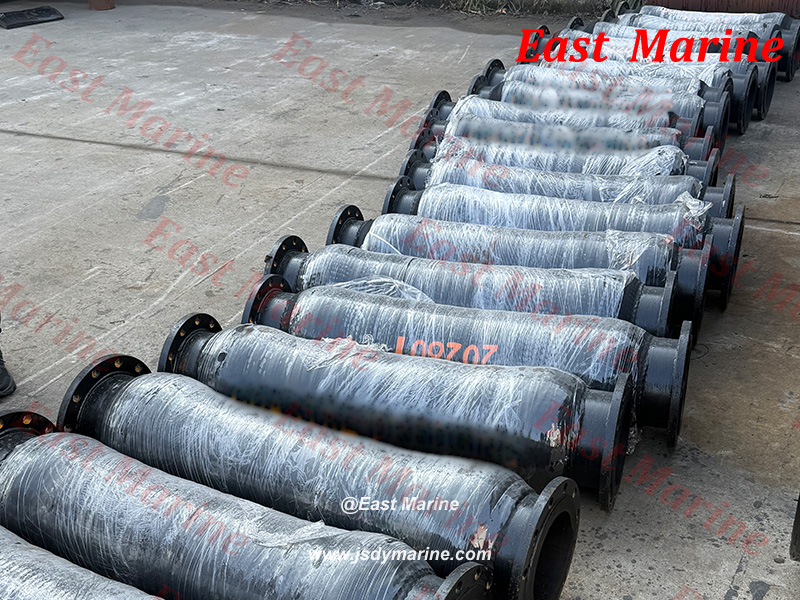
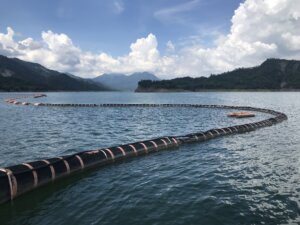
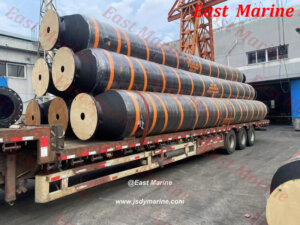
The dredging floating rubber hose is an integrated flexible pipeline specifically engineered for waterborne dredging operations. It combines a sealed buoyancy structure with a high-strength, wear-resistant rubber hose body, enabling stable flotation without the need for additional floats or pontoons.
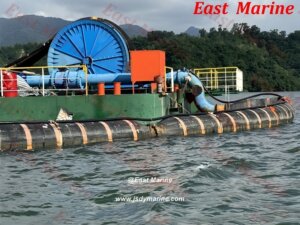
The hose can be directly connected to cutter suction dredgers (CSD) and trailing suction hopper dredgers (TSHD), forming a continuous and efficient fully floating dredging pipeline system. It is widely used in port and channel maintenance, offshore dredging, river and lake desilting, and land reclamation projects, serving as a core conveying solution.
I. Core Structure and Performance Advantages
This series adopts an integrated composite design, ensuring reliable performance under complex marine and offshore conditions, with easy operation and maintenance.
1. Built-in Closed-Cell Buoyancy System
The hose features high-density independent closed-cell foam flotation units. These are fully sealed, water-resistant, and maintain long-term buoyancy without degradation.
The exposed floating area is no less than 20% of the total hose surface, ensuring stable and uniform flotation. This eliminates the need for external floats, significantly reducing installation complexity and project costs.
2. Superior Wear Resistance and Extended Service Life
The outer layer is made of specially formulated rubber with excellent resistance to seawater corrosion, UV exposure, aging, and abrasion, making it suitable for long-term outdoor marine operations.
High-end models include a visual wear indicator layer, allowing operators to monitor abrasion levels and plan maintenance proactively.
The inner lining is made of highly wear-resistant rubber, offering superior performance compared to conventional steel pipes when handling high-density slurry and fine sand, resulting in a significantly longer service life.
3. Excellent Flexibility for Complex Sea Conditions
The hose provides outstanding flexibility, with strong resistance to bending, torsion, and tensile forces. It adapts seamlessly to waves, tides, and vessel movements without rigid deformation or stress cracking.
Even in harsh offshore environments, it maintains stable operation with minimal failure rates.
4. Stable Pressure Performance and High Conveying Efficiency
The hose is reinforced with high-strength layers to ensure excellent pressure resistance, vacuum resistance, and anti-collapse performance.
Its smooth internal design reduces flow resistance, ensuring efficient slurry transport and enabling continuous long-distance, high-concentration dredging operations.
II. Product Range and Classification
Our self-floating dredging hoses are available in a full range of configurations and can be customized according to project conditions, transported media, and operating environments:
| Standard Self-Floating Discharge Hose | Suitable for general inland waterway dredging, port maintenance, and reclamation projects |
| Tapered Self-Floating Discharge Hose | Designed for pipeline diameter transitions, ensuring smooth flow without sedimentation or stress concentration |
| Half-Floating Discharge Hose | Ideal for nearshore, shallow water, and shoreline transition zones, with balanced buoyancy and weight |
| Self-Floating Armored Discharge Hose | Reinforced with high-strength steel rings for resistance to crushing, collapse, and abrasion from sharp materials such as gravel and stones; widely used in offshore and deep-sea dredging |
| Self-Floating Steel Pipe Composite Hose | Combines rigidity and flexibility, suitable for long-distance, high-pressure, and heavy-duty conveying applications |
III. Application of Floating Pipeline System
In large-scale dredging projects such as channel maintenance, port construction, and land reclamation, pipeline systems are typically divided into three sections:
–Floating pipeline (on water)
–Submerged pipeline (underwater)
–Onshore pipeline
Traditional systems rely on steel or HDPE pipes combined with external floats and rubber hoses. These systems often suffer from complex installation, float damage, poor wave resistance, high failure rates, and high maintenance costs.
The floating pipeline system replaces the conventional “rigid pipe + external float” configuration with integrated floating hoses, offering significant advantages:
–Simplified installation with no need for float mounting
–Smooth and natural floating alignment with no localized stress concentration
–Superior resistance to waves, tension, and torsion
–High operational stability with minimal risk of leakage or damage
–Excellent resistance to wear, aging, and seawater corrosion
–Easy installation, dismantling, and maintenance with lower lifecycle costs
It has become the preferred solution for large-scale dredging projects both domestically and internationally.
IV. Safety Guidelines and Maintenance Instructions
To ensure safe and stable operation and maximize service life, the following guidelines must be strictly followed:
1.Do not exceed the designed working pressure, minimum bending radius, or allowable torsion angle to prevent fatigue damage and structural failure.
2.Ensure natural and smooth pipeline layout during installation. Avoid forced twisting, sharp bending, or excessive pulling.
3.For transitions between floating, submerged, and shoreline sections, use dedicated slope transition hoses. Do not use multiple short hoses as substitutes.
4.Assess sea conditions, tides, and wave levels before operation. Install proper anchoring and positioning systems to prevent displacement or breakage.
5.Clean flange sealing surfaces thoroughly before connection. Tighten bolts evenly in a diagonal sequence to ensure proper sealing and avoid leakage.